The Jolly Roger
Pirate flag signaling identity and terms of surrender.

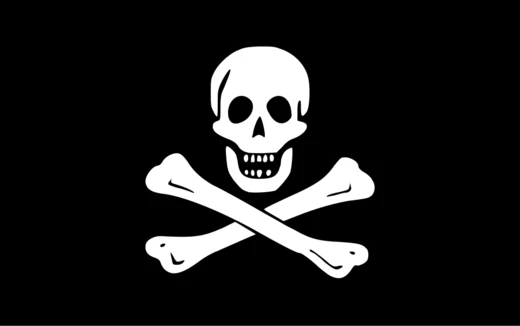
The Jolly Roger was the ensign flown by pirate ships preceding or during an attack during the early 18th century, the latter part of the Golden Age of Piracy. The vast majority of such flags featured a human skull, or 'Death's Head,' often with other elements, on a black field, sometimes called the 'Death's Head flag' or just the 'black flag.' The skull-and-crossbones design on a black flag, most commonly identified as the Jolly Roger today, was used during the 1710s by pirate captains including Samuel Bellamy, Edward England, and John Taylor, and became the most common pirate flag during the 1720s.
- field
- Piracy
- era
- Early 18th century (Golden Age of Piracy)
- known_for
- Pirate ensign used to communicate identity and demand surrender
- associated_captains
- Samuel Bellamy, Edward England, John Taylor, Bartholomew Roberts, Francis Spriggs
Lore & Background
The term 'Jolly Roger' in reference to pirate flags goes back to at least Charles Johnson's A General History of the Pyrates (1724). Neither Roberts's nor Spriggs's flag consisted of a skull and crossbones.
Reader's Guide
The Jolly Roger was not flown at all times; it was a communication tool. Pirates would often fly a false flag until within range, then raise the black flag, often with a warning shot, to persuade the target to surrender without a fight. Surrendering meant the target would cooperate and allow pirates to rifle through cargo, sometimes leaving some goods untouched. If the target did not strike its flag to signal surrender, pirates would raise a red flag, signaling 'no quarter'—that cargo would be taken by force and no lives spared. This black-and-red flag tactic was not universal; for example, Charles Vane used a different approach. The flag's origins are uncertain; some connect it to Barbary pirates and the Muslim Black Standard, but an early 1625 reference to Muslim corsairs flying a skull symbol describes it on a green flag. Claims that 'Jolly Roger' derives from 'Joli Rouge' or 'Ali Rajah' are discounted by historians for lack of period evidence.
Did You Know?
- The term 'Jolly Roger' was used generically for black pirate flags by at least 1724, not for a single design.
- Bartholomew Roberts and Francis Spriggs both named their flags 'Jolly Roger,' but neither design was a skull and crossbones.
- Pirates used a red flag to signal 'no quarter' would be given, while the black flag signaled quarter if the target surrendered.
Common Misconceptions (Editorial)
1. A common misconception is that the term "Jolly Roger" originally referred specifically to the skull-and-crossbones design. In fact, the term was used generically for black pirate flags by at least 1724, and both Bartholomew Roberts and Francis Spriggs named their flags "Jolly Roger" even though neither featured a skull and crossbones. 2. Another misconception is that all pirate flags were identical. The facts show that different captains flew different designs; for instance, the skull-and-crossbones design was used by some captains in the 1710s, while others like Roberts and Spriggs had flags that did not consist of a skull and crossbones.
Why It Matters (Editorial)
The Jolly Roger endures as a potent cultural symbol of piracy precisely because it represents the defiance and lawlessness of the Golden Age of Piracy. Its stark imagery—a black flag promising surrender or death—captures the high-stakes drama of an era when a single flag could dictate whether a merchant ship would yield peaceably or face a bloody fight.
Frequently Asked Questions
What is The Jolly Roger in the context of early 18th-century piracy?
It was the ensign raised by pirate vessels right before or during an attack, serving as a recognizable signal to merchant crews that they were about to be boarded. The term most commonly refers to the black flag bearing a skull-and-crossbones motif that dominated the latter part of the Golden Age of Piracy.
What does The Jolly Roger actually look like?
The classic design places a human skull—often called a 'Death's Head'—with crossed bones beneath it on a solid black background. Some variants added extra symbols, but the skull-and-crossbones-on-black layout became the standard image fans and historians picture when they hear the name.
Which pirate captains are most closely linked to The Jolly Roger?
Samuel Bellamy, Edward England, and John Taylor all flew the skull-and-crossbones black flag during the 1710s, and the design is also associated with Bartholomew Roberts and Francis Spriggs. Together they helped cement the flag as the single most recognizable pirate emblem of the era.
What practical purpose did The Jolly Roger serve during a raid?
Raising the flag was a non-verbal communication tool: it announced the attackers' identity and effectively demanded the merchant crew surrender without a fight. In that sense it functioned as both a threat and a set of terms offered to the target ship.
Why does The Jolly Roger matter to the broader story of the Golden Age of Piracy?
It crystallized the otherwise chaotic world of early-18th-century piracy into a single, instantly readable symbol that signaled who was attacking and what was expected of the victims. Its dominance in the 1710s turned a practical signaling device into the defining visual shorthand for piracy itself.
More in Pirates 1-21
Spotted an error? Know more?
This is a living reference — every entry is fact-audited, and reader corrections feed straight into our audit queue. Suggest an edit · See this site's audit record