Henry Morgan
Welsh privateer, plantation owner, and lieutenant governor of Jamaica.

via Wikipedia: Henry Morgan · see source
Sir Henry Morgan (c. 1635 – 25 August 1688) was a Welsh privateer, plantation owner and, later, the lieutenant governor of Jamaica. From his base in Port Royal, Jamaica, he and those under his command raided settlements and shipping on the Spanish Main, from which he profited. With the prize money and plunder from these raids, Morgan purchased three large sugar plantations in Jamaica. Much of his early life is unknown; he was born in an area of Monmouthshire that is now part of the city of Cardiff. It is not known how he reached the West Indies or how he began his career as a privateer.
- born
- c. 1635 in Monmouthshire (now part of Cardiff), Wales
- died
- 25 August 1688
- field
- Privateer, plantation owner, lieutenant governor
- nationality
- Welsh
- known_for
- Raiding Spanish settlements and shipping; later lieutenant governor of Jamaica
Lore & Background
Much of Morgan's early life is unknown. He was born Harri Morgan around 1635 in Wales, either in Llanrumney or Pencarn (both in Monmouthshire, between Cardiff and Newport). The historian David Williams observes that attempts to identify his parents and antecedents 'have all proved unsatisfactory', although his will referred to distant relations. Several sources state Morgan's father was Robert Morgan, a farmer. Nuala Zahedieh states that details of Morgan's early life and career are uncertain, although in later life he stated that he had left school early and was 'much more used to the pike than the book'. It is unknown how he made his way to the Caribbean. He may have travelled as part of the army of Robert Venables in 1654, or served as an apprentice to a maker of cutlery for three years in exchange for the cost of his emigration. Richard Browne, who served as surgeon under Morgan in 1670, stated that Morgan had travelled either as a 'private gentleman' soon after the 1655 capture of Jamaica, or may have been abducted in Bristol and transported to Barbados, where he was sold as a servant. It is probable that in the early 1660s Morgan was active with a group of privateers led by Sir Christopher Myngs attacking Spanish cities when England was at war with Spain. It is likely that in 1663 Morgan captained one of the ships in Myngs' fleet, and took part in the attack on Santiago de Cuba and the Sack of Campeche. Sir Thomas Modyford was appointed Governor of Jamaica in February 1664. In August 1665 Morgan, along with fellow captains John Morris and Jacob Fackman, returned to Port Royal with a large cargo of valuables. In early 1666 Morgan married his cousin, Mary Morgan, the daughter of Edward, the island's Deputy Governor. The couple had no children. In 1667 diplomatic relations between England and Spain worsened, and Modyford issued a letter of marque to Morgan 'to draw together the English privateers and take prisoners of the Spanish nation'. He was given the rank of admiral and, in January 1668, assembled 10 ships and 500 men; he was subsequently joined by 2 more ships and 200 men from Tortuga. Morgan's initial plan was to attack Havana, but on discovering it was heavily defended, changed the target to Puerto del Príncipe (now Camagüey), a town 50 miles inland. Morgan and his men took the town, but the treasure obtained was less than hoped for. According to Alexandre Exquemelin, who sailed with Morgan, 'It caused a general resentment and grief, to see such a small booty'. After dividing the spoils, Morgan announced a plan to attack Porto Bello (now in modern-day Panama), the third largest and strongest city on the Spanish Main. In 1668, he sailed to Maracaibo, Venezuela, and Gibraltar, on Lake Maracaibo; he plundered both cities before destroying a Spanish squadron during his escape. In 1671, Morgan and his men attacked Panama City, landing on the Caribbean coast and crossing the isthmus and its jungles before attacking the city, located on the Pacific coast. This took place after the signing of a peace treaty. To appease the Spanish, Morgan was arrested and summoned to London in 1672; despite this, he was received favourably in England and soon regained the favour of the government and King Charles II. Morgan was appointed a Knight Bachelor in November 1674 and returned to the Colony of Jamaica shortly afterwards to serve as the territory's lieutenant governor. He served on the Assembly of Jamaica until 1683; on three occasions, he acted as governor in the absence of the post-holder. His reputation was later affected by a memoir by Alexandre Exquemelin, a former Flemish shipmate of Morgan, which accused him of torture and other offences, including during the raid on Panama City. Morgan won a libel suit against the book's English publishers, but Exquemelin's account influenced later portrayals of him. After his death in 1688, Morgan became the inspiration for pirate-themed works of fiction across a range of genres.
Reader's Guide
Morgan's significance lies in his dual role as a successful privateer and a colonial administrator. His raids on Spanish settlements, though often exceeding his official commission, brought substantial wealth to Jamaica and helped secure English influence in the Caribbean. His arrest after the Panama City raid, which violated a peace treaty, illustrates the tensions between private profit and state diplomacy. His knighthood and appointment as lieutenant governor show his rehabilitation and integration into the colonial establishment. His legacy was later shaped by a memoir by Alexandre Exquemelin, a former shipmate, which accused him of torture and other offenses. Morgan won a libel suit against the book's English publishers, but Exquemelin's account influenced later portrayals of him. After his death, Morgan became the inspiration for pirate-themed works of fiction across a range of genres, cementing his place in popular culture as a figure of adventure and controversy.
Did You Know?
- Morgan purchased three large sugar plantations in Jamaica with prize money and plunder from his raids.
- He was probably a member of a group of raiders led by Sir Christopher Myngs in the late 1650s during the Anglo-Spanish War.
- In 1668, after taking Puerto del Príncipe, Morgan hanged an English sailor for killing a French shipmate, keeping his promise to the French sailors.
- Morgan was appointed a Knight Bachelor in November 1674 and returned to Jamaica as lieutenant governor.
- He won a libel suit against the English publishers of Alexandre Exquemelin's memoir, which accused him of torture and other offenses.
Origins Shrouded in Mystery
Harri Morgan, later known as Sir Henry, was born around 1635 somewhere in Monmouthshire, Wales — most likely in Llanrumney or Pencarn, both of which now fall within the greater Cardiff area. Despite centuries of scholarly effort, no one has been able to pin down his parents with confidence. One historian noted that all attempts to trace his antecedents have proved unsatisfactory, though his will does reference distant relations. Some sources name a farmer called Robert Morgan as his father, but this remains unverified. Morgan himself later claimed he left school early and was far more accustomed to handling a pike than a book.
How a young Welshman ended up in the Caribbean remains one of the great biographical puzzles. He may have sailed with Oliver Cromwell's 1654 expedition under Robert Venables, or perhaps served a three-year apprenticeship making cutlery in exchange for passage. Another account suggests he arrived as a private gentleman shortly after the English seized Jamaica in 1655, while a more colourful story has him abducted in Bristol and sold into servitude in Barbados. Whatever the truth, the seventeenth-century Caribbean presented young men with a rare chance to amass wealth quickly, and Morgan clearly seized that opportunity.
The Privateer's Golden Age
By the early 1660s Morgan had thrown in his lot with the privateering fleet of Sir Christopher Myngs, striking Spanish settlements across the Caribbean during the Anglo-Spanish War. He likely captained a vessel in Myngs' 1663 assault on Santiago de Cuba and the Sack of Campeche on the Yucatán Peninsula.
In Jamaica, Governor Sir Thomas Modyford initially tried to curb the roughly 1,500 privateers who used the island as a staging ground, but the young colony's fragile economy depended on their revenue, and he reversed course within a month. When tensions with Spain escalated in 1667, Modyford — a close friend of Morgan's — issued him a letter of marque authorising attacks on Spanish shipping.
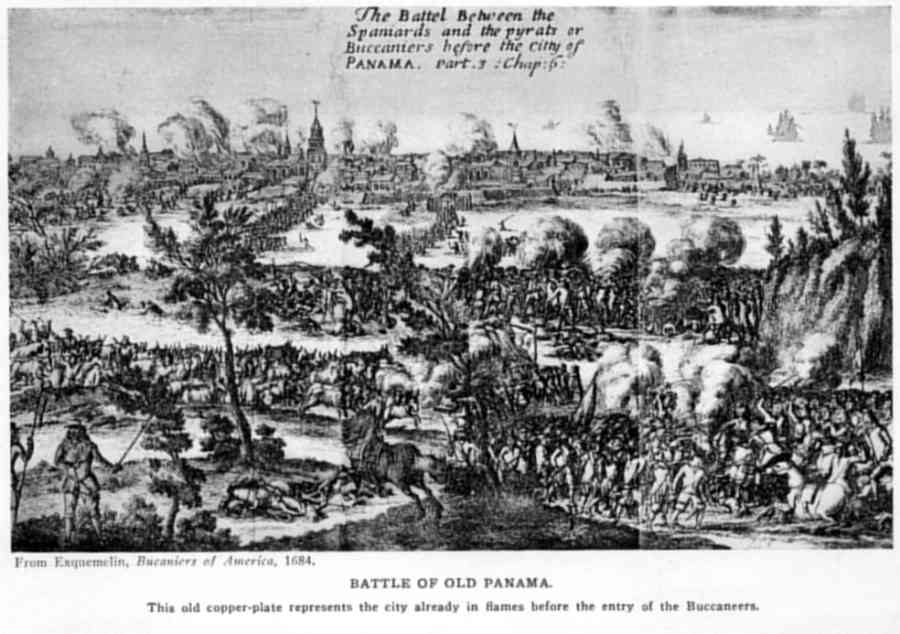
Armed with that licence, Morgan struck Puerto del Príncipe on Cuba's coast and Porto Bello in present-day Panama. In 1668 he sailed to Lake Maracaibo in Venezuela, plundering both Maracaibo and the settlement of Gibraltar before destroying a Spanish squadron during his escape. His 1671 assault on Panama City remains his most audacious: landing on the Caribbean coast, his men trekked through the jungles of the isthmus to hit the city on the Pacific side — a feat carried out after a peace treaty had already been signed.
From Prisoner to Knight Governor
The Panama raid, carried out in violation of a recently signed peace treaty, created a diplomatic crisis. To appease the Spanish crown, Morgan was arrested in 1672 and summoned to London. By any other measure, this might have ended his career. Instead, he was received favourably in England, quickly regained the confidence of the government, and won the personal approval of King Charles II.
In November 1674 the king elevated Morgan to Knight Bachelor, and he returned to Jamaica to serve as the colony's lieutenant governor. He went on to sit on the Assembly of Jamaica until 1683, and on three separate occasions he stepped in to act as governor when the post-holder was absent. His wealth from years of privateering allowed him to purchase three large sugar plantations on the island, anchoring him firmly in the planter class.
His close friendship with Governor Modyford had been central to his rise, and Morgan maintained his standing well into the 1680s. He died on 25 August 1688, still holding his knighthood and his estates — a man who had transformed from a nameless Welsh youth into one of the most powerful figures in the English Caribbean.
The Exquemelin Shadow and Pirate Legend
Long after Morgan's death in 1688, his reputation became entangled with a book he never asked for. Alexandre Exquemelin, a former Flemish shipmate of Morgan, published a memoir accusing the Welshman of torture and other grave offences, particularly during the 1671 Panama raid. Morgan, still alive at the time, took legal action against the English publishers of the book and won his libel suit. Yet the damage to his public image proved far from reversible.
Exquemelin's account shaped how later generations understood Morgan, casting him as a brutal and ruthless figure rather than the politically connected privateer and plantation owner he had been in life. The memoir fed directly into the broader cultural imagination of the Caribbean as a place of lawless violence and moral ambiguity.
After his death, Morgan's name became inseparable from the pirate myth. He inspired pirate-themed works of fiction across a wide range of genres, ensuring that the real Harri Morgan of Monmouthshire would be remembered less for his sugar plantations and his knighthood than for the shadowy, violent figure his rivals had helped create in the public mind.
Common Misconceptions (Editorial)
1. Many people assume Henry Morgan was a pirate, but the facts show he was a privateer acting under official letters of marque, and he later became a respected plantation owner and lieutenant governor of Jamaica. 2. It is often believed Morgan was a lifelong criminal or rogue, yet he was knighted by King Charles II in 1674 and even won a libel suit against Alexandre Exquemelin’s memoir, which had accused him of torture. 3. Some think Morgan died destitute or in obscurity, but he owned three large sugar plantations in Jamaica and died in 1688 as a wealthy and politically powerful figure.
Why It Matters (Editorial)
Henry Morgan endures in popular culture as the archetypal Caribbean buccaneer, but his real story complicates the romanticized image of pirates as lawless rebels. His life reflects the blurred lines between state-sanctioned violence, colonial ambition, and personal fortune in the 17th century—a reminder that history’s most famous “pirates” were often instruments of empire.
Gallery
Frequently Asked Questions
Who is Henry Morgan?
Sir Henry Morgan was a Welsh privateer who operated out of Port Royal, Jamaica, in the mid-1600s. He later transitioned into a plantation owner and went on to serve as lieutenant governor of Jamaica.
What was Henry Morgan's role and how did he make his fortune?
Morgan used his base in Port Royal to launch raids against Spanish settlements and merchant shipping across the Caribbean. He channeled the wealth he plundered into buying three large sugar plantations.
How does Henry Morgan's story end?
His unauthorized attack on Panama City after a peace treaty had been signed triggered his arrest and a summons to London, where he ultimately won back the king's goodwill and received a knighthood. He passed away on 25 August 1688.
Why is Henry Morgan important in pirate history?
Morgan stands out as one of the most celebrated privateers of the seventeenth century, remembered for his daring strikes against Spanish colonial targets. His unusual arc from outlaw sea-raider to appointed colonial governor makes him a singular figure in maritime history.
Where was Henry Morgan from and what was his nationality?
Morgan was born around 1635 in Monmouthshire, an area that is now part of modern-day Cardiff. He was Welsh by birth and carried that identity through his entire career as a privateer and colonial administrator.
More in Pirates 1-21
Spotted an error? Know more?
This is a living reference — every entry is fact-audited, and reader corrections feed straight into our audit queue. Suggest an edit · See this site's audit record