
William Kidd
Scottish privateer turned pirate, executed in 1701.

via Wikipedia: William Kidd · see source
William Kidd (c. 1645 – 23 May 1701), also known as Captain William Kidd or simply Captain Kidd, was a Scottish privateer. Conflicting accounts exist regarding his early life, but he was likely born in Dundee and later settled in New York City. By 1690, Kidd had become a highly successful privateer, commissioned to protect English interests in the Thirteen Colonies in North America and the West Indies. In 1695, Kidd received a royal commission from the Earl of Bellomont to hunt down pirates and enemy French ships in the Indian Ocean. He received a letter of marque and set sail on a new ship, Adventure Galley, the following year. On his voyage he failed to find many targets, lost much of his crew and faced threats of mutiny. In 1698, Kidd captured his greatest prize, the 400-ton Quedagh Merchant, a ship hired by Armenian merchants and captained by an Englishman. The political climate in England had turned against him, however, and he was denounced as a pirate. Bellomont engineered Kidd's arrest upon his return to Boston and sent him to stand trial in London. He was found guilty and hanged in 1701.
- born
- c. 1645, likely Dundee, Scotland
- died
- 23 May 1701, London, England
- field
- Privateering, piracy
- nationality
- Scottish
- known_for
- Royal commission to hunt pirates, capture of the Quedagh Merchant, trial and exe
Lore & Background
William Kidd was born in Dundee, Scotland prior to 15 October 1645. While claims have been made of alternative birthplaces, including Greenock and Belfast, he said himself he came from Dundee in a testimony given by Kidd to the High Court of Admiralty in 1695. As a young man, Kidd settled in New York City, where he befriended many prominent colonial citizens, including three governors. By 1689, he was a member of a French–English pirate crew sailing the Caribbean under Captain Jean Fantin. During one of their voyages, Kidd and other crew members mutinied, ousting the captain and sailing to the British colony of Nevis. There they renamed the ship Blessed William, and Kidd became captain either as a result of election by the ship's crew, or by appointment of Christopher Codrington, governor of the island of Nevis. He later married Sarah Bradley Cox Oort on 16 May 1691; she was one of the wealthiest women in New York. In 1695, Kidd received a royal commission from the Earl of Bellomont to hunt down pirates and enemy French ships in the Indian Ocean. He received a letter of marque and set sail on a new ship, Adventure Galley, the following year. On his voyage he failed to find many targets, lost much of his crew and faced threats of mutiny. In 1698, Kidd captured his greatest prize, the 400-ton Quedagh Merchant, a ship hired by Armenian merchants and captained by an Englishman. The political climate in England had turned against him, however, and he was denounced as a pirate. Bellomont engineered Kidd's arrest upon his return to Boston and sent him to stand trial in London. He was found guilty and hanged in 1701.
Reader's Guide
William Kidd's significance lies in his transformation from a commissioned privateer to a convicted pirate, a shift that reflects the volatile political and legal landscape of late 17th-century English colonialism. His capture of the Quedagh Merchant, while arguably legal under his commission, occurred when English politics had turned against him, leading to his arrest and execution. Kidd's trial and hanging served as a warning to other privateers and pirates, but his legend grew after death. The belief that he had left buried treasure contributed significantly to his legend, which inspired numerous treasure hunts in the following centuries. Kidd was romanticised after his death and his exploits became a popular subject of pirate-themed works of fiction. His story illustrates the thin line between sanctioned privateering and piracy, and how political patronage could determine a man's fate. The enduring mystery of his supposed treasure has kept his name alive in popular culture, making him one of the most famous figures associated with piracy, despite his relatively brief and unsuccessful career as a pirate.
Did You Know?
- Kidd killed his own gunner, William Moore, on 30 October 1697 by dropping an ironbound bucket on his head after Moore urged him to attack a Dutch ship.
- Kidd's ship Adventure Galley was equipped with 34 cannon and oars, giving it a key advantage in battle when winds calmed.
- Kidd married Sarah Bradley Cox Oort on 16 May 1691; she was one of the wealthiest women in New York, having been twice widowed.
- Kidd's quartermaster, Hendrick van der Heul, is described in a contemporary source as a 'small black Man' and may be the highest-ranking black pirate or privateer so far identified.
- Kidd was arrested in Boston after the Earl of Bellomont engineered his capture, then sent to London for trial.
From Dundee to the Colonial Seas
William Kidd was born in Dundee, Scotland, before October 15, 1645—a detail he personally confirmed in 1695 testimony before the High Court of Admiralty. While Greenock and Belfast have been suggested as alternative birthplaces, baptism records in Dundee align with his own account. After his father's death, a local society provided the family with financial assistance. The popular notion that his father served as a Church of Scotland minister has been largely undermined, as the name does not appear in comprehensive church records for the period. As a young man, Kidd settled in New York City, which the English had recently taken from Dutch hands. He built connections with prominent colonial citizens, including three governors. Some accounts indicate he briefly apprenticed aboard a pirate ship during this time. By 1689, he was sailing the Caribbean as part of a French-English crew under Captain Jean Fantin. When Kidd and other crew members mutinied, they sailed to the British colony of Nevis, where the vessel was renamed Blessed William and Kidd took command, either by crew vote or by appointment of Governor Christopher Codrington.
The Royal Commission and the Adventure Galley
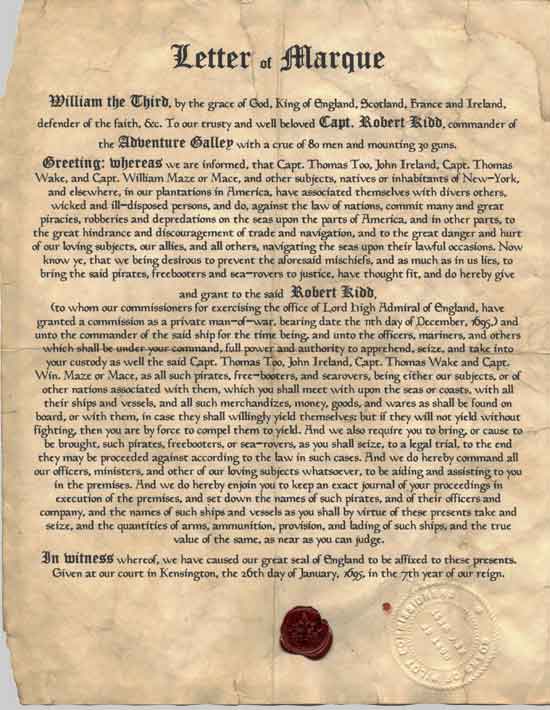
On December 11, 1695, Richard Coote, 1st Earl of Bellomont—governing New York, Massachusetts, and New Hampshire—issued a royal commission directing Kidd to pursue named pirates and enemy French vessels in the Indian Ocean. Refusing would have carried the stigma of disloyalty. The venture's cost was largely underwritten by some of England's most powerful figures, including the Earl of Orford, the Baron of Romney, the Duke of Shrewsbury, and Sir John Somers. Kidd received a letter of marque signed personally by King William III, reserving ten percent of any loot for the Crown. The new vessel, Adventure Galley, displaced over 284 tons and carried 34 cannon, 150 men, and—crucially—oars that let her maneuver when winds died and rival ships sat helpless. Kidd personally hand-picked his crew, selecting only those he deemed the most loyal. Yet even before departure, trouble followed: as the ship sailed down the Thames, Kidd failed to salute a Navy yacht at Greenwich, and his crew answered the Navy's warning shot by turning and slapping their backsides in open disdain. The Navy captain retaliated by pressing much of Kidd's crew into naval service, leaving him short-handed at sea.
Betrayal, Trial, and the Gallows
The voyage that was meant to be a triumph of royal authority became a disaster. Kidd failed to find many targets, lost much of his crew, and faced persistent threats of mutiny. In 1698, he finally captured his greatest prize: the 400-ton Quedagh Merchant, a ship hired by Armenian merchants and captained by an Englishman. Yet by the time Kidd returned, the political climate in England had shifted decisively against him. He was denounced as a pirate rather than a privateer. Bellomont, who had originally commissioned the voyage, engineered Kidd's arrest upon his return to Boston and arranged for him to be sent to London to stand trial. The outcome was inevitable: Kidd was found guilty and hanged on May 23, 1701. What had begun as a Crown-sanctioned mission to protect English interests in the Thirteen Colonies and the West Indies—Kidd had been a highly successful privateer by 1690—ended in the gallows, a victim of shifting political winds and the enmity of powerful men who had once bankrolled his expedition.
The Legend of Captain Kidd
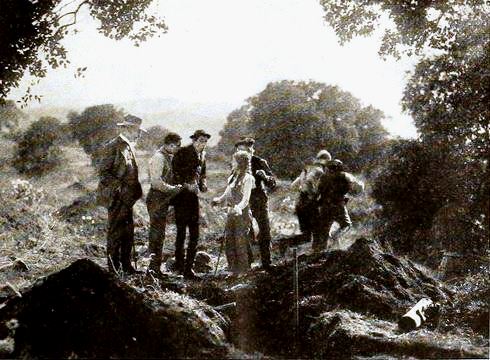
After his execution, William Kidd did not fade into obscurity. Instead, he was romanticised, and his exploits became a popular subject of pirate-themed works of fiction that have endured for over three centuries. The belief that he had left buried treasure contributed significantly to his legend, inspiring numerous treasure hunts in the following centuries. What had been a complex story of privateering, political betrayal, and the machinations of colonial governors was distilled into the archetypal pirate narrative. His life had been marked by extraordinary contrasts: a Dundee-born sailor who befriended three colonial governors, who funded the construction of Trinity Church in New York, who married Sarah Bradley Cox Oort—one of the wealthiest women in the city, already twice widowed—on May 16, 1691, and who then sailed into the Indian Ocean under the personal letter of marque of King William III. Yet history remembered him not for these details but for the swashbuckling image of a pirate who hid his gold beyond the reach of kings.
Common Misconceptions (Editorial)
A common misconception is that William Kidd was definitively a pirate throughout his career. In fact, he began as a lawful privateer, receiving a royal commission from the Earl of Bellomont in 1695 to hunt pirates and enemy French ships. Another misconception is that he was born in Ireland or elsewhere; according to his own 1695 testimony to the High Court of Admiralty, he stated he came from Dundee, Scotland.
Why It Matters (Editorial)
William Kidd endures as a figure of fascination because his life illustrates the thin, often blurred line between sanctioned privateering and condemned piracy during the age of sail. His dramatic fall—from a respected captain with a royal commission to a convicted pirate hanged in London—reminds us how quickly political loyalties and public opinion could determine a person’s legacy.
Gallery

Frequently Asked Questions
Who is William Kidd?
William Kidd was a Scottish privateer born around 1645, most likely in Dundee, who later made his base in New York City. He rose to become one of the most notorious figures in maritime history before his life ended on a London scaffold.
What was William Kidd's royal commission?
In 1695, Kidd received an official royal commission authorizing him to pursue pirates and French vessels threatening English trade routes in the Thirteen Colonies and the West Indies. What began as a legitimate state-sanctioned mission ultimately spiraled into accusations of piracy and his own destruction.
What is William Kidd most famous for?
Kidd is best remembered for the capture of the Quedagh Merchant, his 1695 royal commission, and the persistent legend that he concealed a vast buried treasure somewhere. Together, these elements cemented his place as an iconic symbol of the golden age of piracy.
How does William Kidd's story end?
After his commission collapsed and accusations mounted, Kidd was arrested, tried for piracy, and hanged in London on 23 May 1701. His execution transformed him from a commissioned privateer into one of history's most enduring pirate villains.
Why is William Kidd important in pirate history?
Kidd occupies a unique space between state-authorized privateering and outright piracy, illustrating how colonial economics and royal politics shaped life on the high seas. His story also gave rise to the buried-treasure myth that continues to captivate audiences to this day.
More in Pirates 1-21
Spotted an error? Know more?
This is a living reference — every entry is fact-audited, and reader corrections feed straight into our audit queue. Suggest an edit · See this site's audit record